
Understand St. Joseph Property Values
Michigan splits its value terms across separate steps in assessment and taxation. Real and personal property is assessed at 50 percent of true cash value for equalization purposes. This figure comes from St. Joseph County Equalization. The local assessor sets the value for one parcel. That work belongs to the city, village, or township, not to county Equalization.
| Value | What It Is | Where |
|---|---|---|
| Assessed value | The assessor's value within Michigan's assessment system | Local assessment roll |
| State equalized value | Assessed value after county and state equalization | Roll and equalization records |
| Taxable value | The value used in the tax calculation, subject to Michigan rules | Local roll |
| Last sale or consideration | A transfer date or amount tied to a recorded event | GIS field and deed |
Assessed value is not the sale price. True cash value comes from mass assessment. An actual price is set by one buyer and one seller. Taxable value can diverge too. Michigan ownership-change, cap, exemption, loss, and addition rules all move it. The county's equalization explanation lays out the 50 percent true-cash-value framework and the county-versus-local split.
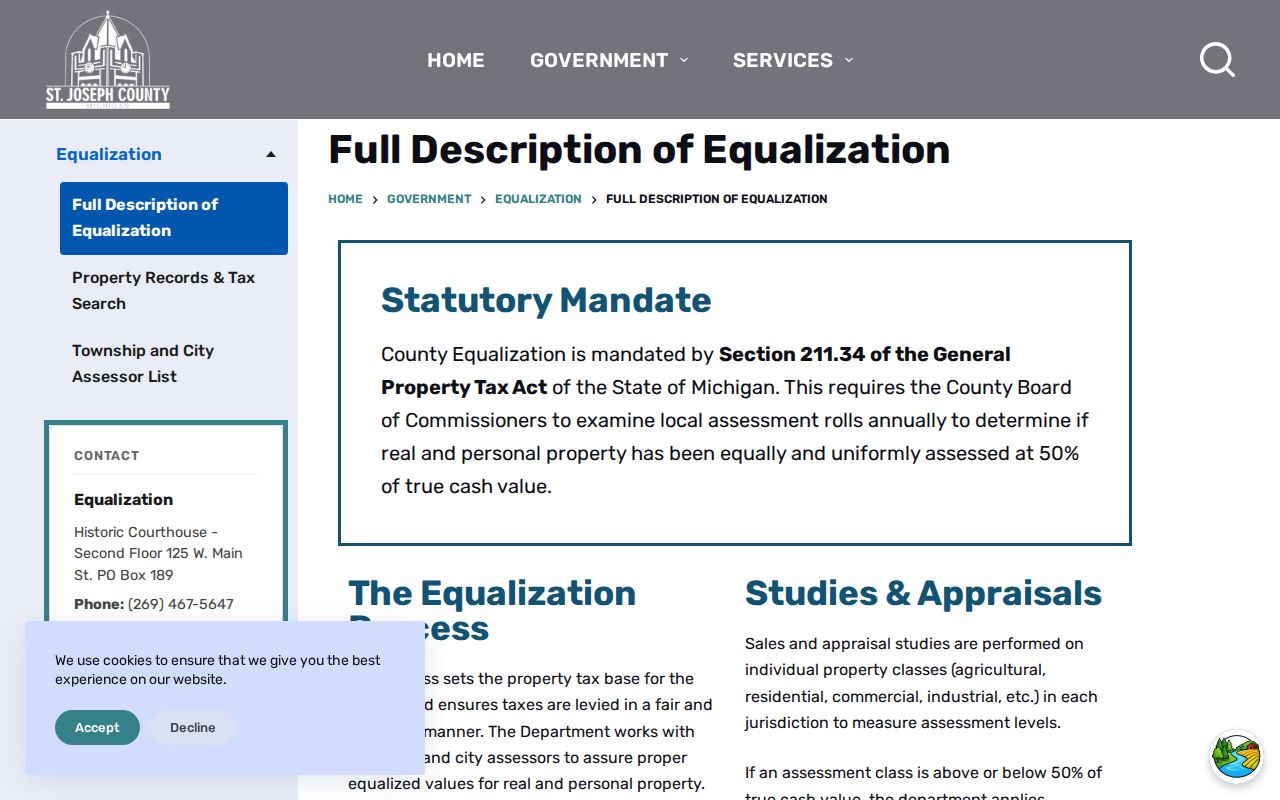
The official explanation helps you separate an assessment-system number from a current sale estimate or a private appraisal.
Estimate a St. Joseph County Value
Begin with the county's Property Records and Tax History Search. FetchGIS is free, requires no account, and is described as updated daily. Enter the exact Tax_ID where you can, so the value stays tied to the correct land.
- Find the parcel by Tax_ID or exact situs address and confirm the legal-description clues.
- Record assessed, equalized, and taxable values with their tax year.
- Note the Last Sale Date, then check the deed for recorded consideration and land description.
- Ask the local assessor for the property card when land or improvement detail is missing.
- Assessed value
- The local assessment before equalization.
- True cash value
- Michigan's value concept tied to usual selling price.
- Assessment ratio
- The relationship between assessed and true cash value.
- Consideration
- The amount stated for a recorded transfer, subject to the instrument's terms.
- Reassessment
- A new review of value for a later roll year.
St. Joseph Equalization Has One Role
County Equalization keeps a database of more than 33,000 parcels. It studies sales and appraisals across property classes. Under MCL 211.34, it may apply an equalization factor. That happens when a class sits above or below the required level. Equalization never replaces the local assessor for a single property's value.
Use the county assessor roster to find your city, village, or township contact. Ask for the current assessment card, the roll year, and any land or improvement detail the public GIS card leaves out.
Sale Consideration Is Separate
A written real-estate instrument must state total consideration on its face. That rule comes from the county's transfer-tax guidance. The deed and transfer-tax amount can therefore hint at a price. Treat that amount as evidence of the recorded transfer only. It is not a full appraisal of current market value.
Match the deed's legal description to the parcel before drawing conclusions. One transfer may cover several parcels, a partial interest, or terms that skew the math. Those terms can make price-per-parcel figures unsound. The Last Sale Date in county GIS is just a date field. Check the instrument itself before trusting it.
Michigan Taxable Value Can Diverge
A transfer of ownership generally uncaps taxable value the following year. Certain statutory exclusions under MCL 211.27a still apply. The buyer usually files a Property Transfer Affidavit with the local assessor within 45 days. A Principal Residence Exemption can change the tax bill. It does not change what the market would pay.
Splits and combinations create new parcel numbers and require a new PRE affidavit. Remember that when a prior year's value seems tied to a different Tax_ID. Tax bills and appeals are covered on the separate property tax records page.
City Trends Need Context
The county's 2024 equalization report showed residential equalized values rising 22.14 percent in Three Rivers and 14.87 percent in Sturgis, while taxable values rose by smaller percentages. That comparison is a city-level signal. It is not a parcel appraisal.
Class totals shift for many reasons: sales, additions, losses, new construction, equalization, and parcel changes. Never apply a city percentage to one house. Rely on the parcel's own assessment record, its physical facts, and relevant sale evidence.
Maps Do Not Price St. Joseph Land
County GIS provides acreage, parcel boundaries, address points, imagery, school districts, and other helpful context. The imagery includes a 2019/2020 one-foot color set and a 1955 black-and-white set. Dates matter here. Old imagery can explain change but cannot supply today's property value.
The 2023 GIS summary reported 968 parcels remapped within plus or minus three feet. Nearly 85 percent of county parcels were remapped. Better line placement aids research. Still, a polygon is not a survey, and acreage alone is not a price.
What St. Joseph Values Cannot Prove
An assessed value exists to support public tax administration. It is not a promise of sale price. It is no inspection of condition, and no opinion on every easement and restriction. A recorded consideration amount describes a past instrument only. It cannot account for later work or today's buyer demand.
Value is not price. A St. Joseph County assessed value is for taxation and is not what a property will sell for or a licensed appraisal.
When a source number looks unclear, request the record behind it. Michigan FOIA allows a written, specific request for an existing assessment card. It also covers a prior roll entry. The county FOIA page links its JustFOIA portal. For broad requests, ask for electronic records and a fee estimate.