
What St. Joseph County Deed Records Convey
The St. Joseph County Clerk/Register of Deeds records deeds, mortgages, liens, land contracts, fixture filings, and other instruments that affect property. The deed type only signals the form of transfer. Its parties, legal description, and reservations control the meaning.
| Deed Type | What It Does | Common Use |
|---|---|---|
| Warranty deed | Transfers an interest with stated covenants | Conventional sale or transfer |
| Quitclaim deed | Transfers whatever interest the grantor holds | Family transfer or correction |
| Trustee deed | Shows a trustee acting for a trust | Trust-held land |
| Personal representative deed | Shows an estate representative acting | Probate administration |
| Tax deed | Documents a transfer through the tax process | Tax-foreclosed property |
A deed transfers an interest. A mortgage or lien is different: it is an encumbrance, a claim against the property. Always search releases and satisfactions early, because an older claim may already be closed. Under Michigan recording rules, survivorship can appear through a recorded or referenced certified death certificate. Some transfers look nothing like a sale. Probate orders, personal representative deeds, and trust instruments explain them, so search the court or estate record when the owner of record changes without a deed.
Tapestry and Laredo Open the St. Joseph County Index
Occasional users reach the index through pay-as-you-go Tapestry from the county's deed search page. Regular researchers can set up a Laredo subscription, agreement, and escrow account through the Register of Deeds. The county publishes no first online index year. Assume no historical cutoff.
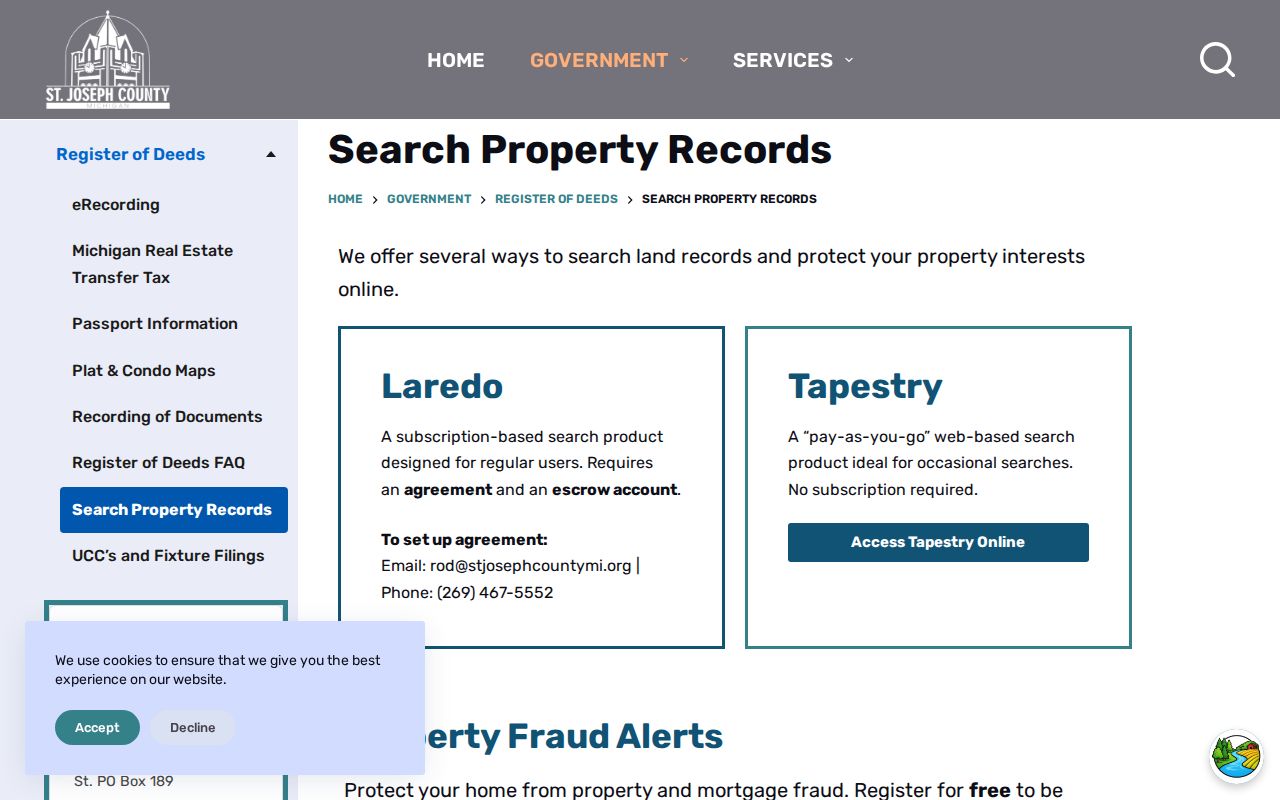
The Tapestry interface is the occasional-user route. On the official deed search page, Tapestry, Laredo, and Property Fraud Alert each serve a different purpose.
Read the instrument itself, not just its index row.
Read the Deed, Not Only Its Index Row
Capture the grantor, grantee, recording date, and the instrument or liber and page reference. Add the consideration, full legal description, and exceptions. Michigan instruments state total consideration on their face. The seller or grantor pays transfer tax under the county schedule. Recorded consideration is not a current appraisal. Transfer tax, assessed value, taxable value, and a later market estimate answer separate questions. The office records documents only. It does not prepare them or give legal advice, so drafting questions go elsewhere. The county's transfer-tax examples show the schedule at work. Consideration from $100 through $500 produces a combined $4.30 tax. The $99,500.01 through $100,000 bracket produces $860. Those figures explain a tax notation on a deed. They do not explain the property's condition, financing concessions, later improvements, or present value.
Walk the St. Joseph County Grantor-Grantee Index
A grantor conveys an interest; a grantee receives it. Start with the latest known deed. Use each grantor as the next name to search backward, matching the land description at every step.
- Identify the current assessment owner and Tax_ID, then search that owner as a grantee.
- Open the newest plausible deed and note its grantor, date, reference, and legal description.
- Search that grantor as a grantee in an earlier period to find the deed by which that person acquired the same land.
- Repeat while comparing subdivision, lot, section, acreage, and exceptions. Ask the office which older reverse index or deed book continues the chain.
- Grantor
- The party conveying an interest.
- Grantee
- The party receiving an interest.
- Chain of title
- The linked sequence of recorded transfers for the same land.
- Book/page or instrument number
- The locator assigned to a recorded document.
St. Joseph County Plats Bridge Names to Land
The county's plat and condominium table lists subdivision name, unit, number, and section. It also covers township and range, quarter sections, and location. Subdivision links open recorded plat PDFs. Quarter-section links open related property tax maps. This bridge works well when an assessment description names a subdivision. Exact spelling matters. An addition, numbered unit, or amended plat may carry its own record.
Note: A recorded plat helps interpret lot-and-block language. It does not replace a licensed boundary survey.
Older St. Joseph County Deed Books Require a Fallback
County public records reach back to the 1830s. Not every deed is promised online. Ask the office for the confirmed online cutoff and the older book route. The county seat moved from White Pigeon to Centreville in 1831. That move gives early research real archival context. The 1872 D.J. Lake atlas and later Library of Michigan county atlases suggest old owners, roads, and sections. Confirm each atlas lead in the deed books and legal descriptions.
Cross-Check St. Joseph County Mortgages and Liens
Search a mortgage under mortgagor and mortgagee names, then look for assignments and a discharge. For liens, hunt the later release or satisfaction. Tax-lien search certificates cost $3 per debtor. County records also include fixture filings and certain land-related UCC instruments, while most personal-property UCC filings sit with the Michigan Secretary of State. The collateral type determines the right office.
A quiet-title judgment or other court order may need recording before it enters the land chain. Dockets show litigation activity. The recorded certified order affects the land-record trail. Read both when a name disappears from ordinary deed transfers or a case corrected a legal description.
Easements and restrictions demand the same discipline. Search the deed's exceptions, referenced plats, separate easement instruments, amendments, and releases. St. Joseph County GIS expressly does not map easements. A map showing no access strip cannot close that part of the inquiry.
St. Joseph County Fraud Alerts Do Not Block Filings
The county links a free Property Fraud Alert service that sends notice whenever a document is recorded in an enrolled name. It is a notification tool only. It is not a title guarantee or filing block.
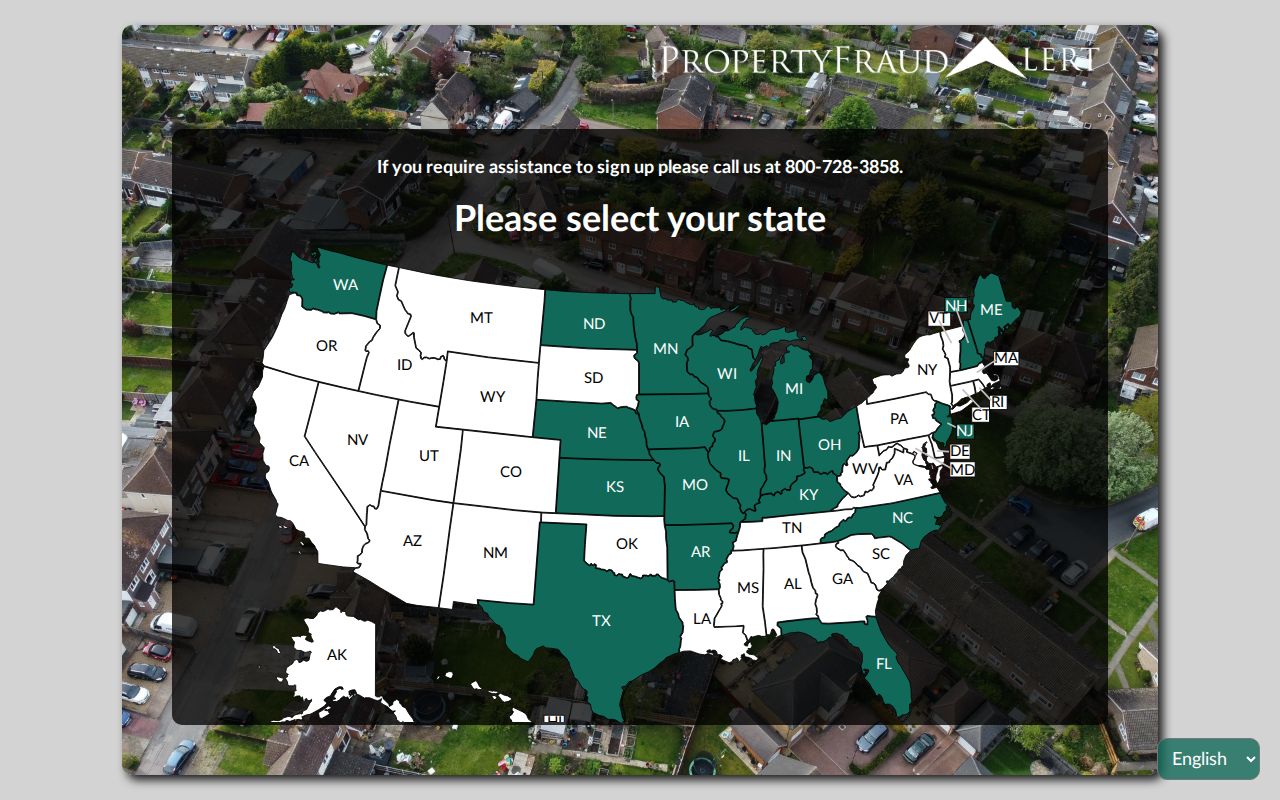
Verify unexpected notices with the office before paying anyone.
Order a St. Joseph County Deed Copy
The St. Joseph County Clerk/Register of Deeds sits on the second floor of the Historic Courthouse at 125 W. Main Street, Centreville. Visitors can also call (269) 467-5552 or mail a request to PO Box 189, Centreville, MI 49032. Have the party names ready, plus a date range, Tax_ID or legal description, and a recording reference if one is known.
Fees are straightforward. Real-estate copies run $1 per page, and certification adds $5 per instrument or copy. An office grantor/grantee or mortgage-party search costs $0.50 per year searched per name, with a $5 minimum. Order large plats through the Land Resource Centre.
Mail and counter requests still matter when an online image is missing. State the party, date range, document type, and any known reference. Because the search charge accrues per year and per name, a focused span keeps costs down. A plain copy suits most research, while certification makes sense only when an official sealed copy is truly required.
Recorded, not guaranteed. The St. Joseph County index shows what was recorded. It does not resolve unrecorded interests, guarantee good title, or settle a boundary.
Starting with just an address? Run the St. Joseph County property search first. Then carry the Tax_ID and owner of record into the deed index.